
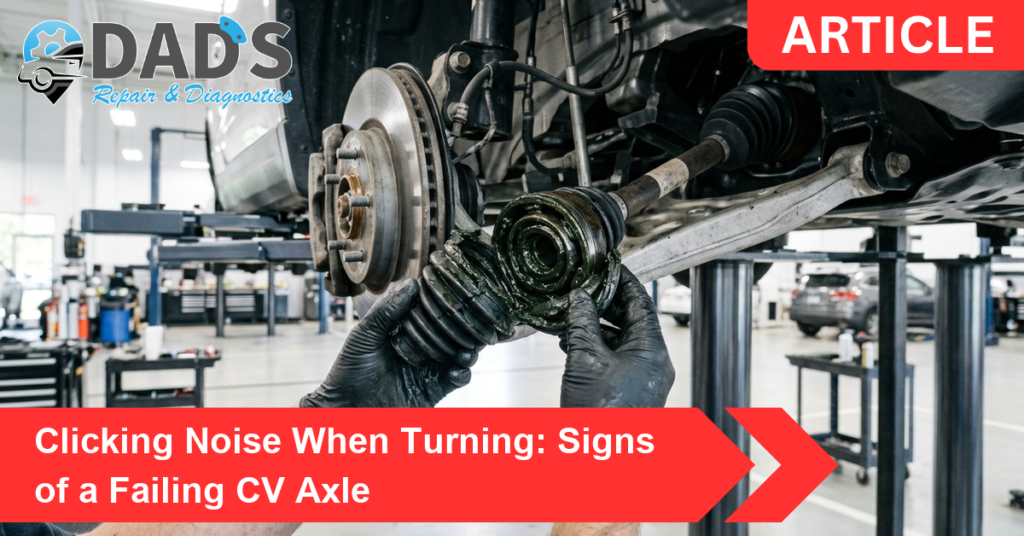
That rhythmic clicking noise when turning is one of the most honest sounds a car makes. It almost always traces back to a worn CV axle, and it tends to get louder the harder you turn. Most drivers in Madera first notice it backing out of the driveway or swinging through a tight parking-lot turn, and it is easy to tune out until it is not. At DADS Auto Repair, a clicking half-shaft is one of the more common drivetrain complaints we hear, and it is also one of the easier ones to confirm.
Here is what the noise is telling you, why it happens, and when it is safe to keep driving versus time to get the car on a lift.
What a Clicking Noise When Turning Really Means
Your front wheels get their power through two CV (constant-velocity) axles. Each axle has a joint packed with grease and sealed inside a ribbed rubber boot. That joint lets the axle keep sending power while the wheel turns and the suspension moves up and down at the same time. When the outer joint wears out, it clicks or pops once per wheel rotation, and turning loads it up so the sound gets sharper and faster.
The usual chain of events starts small. The rubber boot cracks or tears, the grease slings out, road grit and water get in, and the dry joint grinds itself apart over the next few thousand miles. In the Central Valley, that cracked boot ages faster than most people expect. Summer heat hardens the rubber, and the fine dust we all deal with acts like sandpaper once it works into the joint.
The Warning Signs, in the Order They Usually Show Up
- Clicking or popping on turns. The classic tell. Sharper at full lock, and often louder turning one direction than the other, which points to the worn side.
- A grease ring on the inside of a wheel or the pavement. When a boot tears, it flings grease in a telltale arc. That dark film on the inner edge of a tire is a torn CV boot until proven otherwise.
- A clicking sound when accelerating around a turn. Load plus steering angle is the worst case for a tired joint, so merging onto Highway 99 from a curved on-ramp is where a lot of people first hear it clearly.
- A vibration or shudder under hard acceleration. This usually means the inner joint, not the outer one, and it tends to show up later.
- A clunk when shifting into gear or on and off the gas. Play in a badly worn joint takes up with a thunk you can feel through the floor.
Not Every Turning Noise Is a CV Axle
This is where guessing gets expensive. A few other problems make noise in the same neighborhood, and swapping an axle that was fine fixes nothing. A failing wheel bearing makes a humming or growling that changes with speed and shifts as you sway the car left and right, which is different from a CV axle’s crisp click tied to steering angle. Worn suspension parts tend to clunk over bumps rather than click on turns. Low power-steering fluid can groan at full lock. Each of these has its own fingerprint, and we break down how to tell these common vibrations and noises apart in a separate guide.
That is the whole point of our diagnostics-first approach. The DADS tagline is “We Diagnose, We Do Not Guess,” and a clicking half-shaft is a good example of why that matters. We put the car on a lift, check the boots for tears and grease loss, feel each joint for play, and confirm the worn side before we quote a dime of work. If you want the bigger picture of how power gets to your wheels, our overview of your car’s drivetrain walks through where the CV axles sit in the system.
How We Pin Down the Worn Side
Confirming a bad axle takes more than hearing the click. With the front end up, we spin each wheel by hand and watch the joint, flex the axle to feel for notchy play, and run a thumb around every boot looking for the hairline split that started it. A classic shop check is a slow, full-lock circle in an empty lot, forward and then in reverse. The direction that clicks loudest is almost always the failing side. Doing that work up front is what keeps you from paying to replace a good part, which is the trap drivers fall into when a noise gets guessed at instead of verified.
Is It Safe to Keep Driving?
A joint that only clicks on sharp turns will usually get you home and probably through the week. It is not an immediate roadside danger the way a brake problem is. The catch is that it only gets worse, never better, and the failure mode at the end is not subtle: a severely worn outer joint can separate, and if that happens the wheel stops receiving power and the car can lurch. That is a tow and a bad afternoon.
The cheaper path is catching it at the boot stage. If the boot has just started to crack but the joint is still clean and tight, a boot and a repack is a fraction of the cost of a full axle. Once the grease is gone and the clicking starts, the joint is the problem and the whole half-shaft gets replaced. Catching the tear early is the single biggest thing that keeps this repair small, which is why a quick look at the boots during any oil change or tire rotation pays for itself.
What CV Axle Repair Costs in Madera
Prices depend on the vehicle, but a single remanufactured front CV axle replaced on a common car or small SUV generally lands in a few-hundred-dollar range, parts and labor together, with both sides costing more. Larger trucks, all-wheel-drive models, and some imports run higher because the axles are pricier and the job takes longer. Rather than post a one-size-fits-all number, we inspect your car, confirm which axle is actually worn, and hand you a written estimate before any work starts. You approve it first, with no surprise add-ons after the fact.
Our drivetrain service and repair covers CV axles, boots, and the joints that go with them, and a courtesy inspection comes with the visit, so you leave knowing the condition of both sides, not just the one that was talking.
Catch It at the Next Oil Change
The reason a torn boot so often turns into a full axle is simple: nobody looked. A split boot is obvious on a lift and easy to miss from the driver’s seat. That is why every oil change and tire rotation at our Madera Auto Repair shop includes a glance at the CV boots. A thirty-second look can flag a cracked boot while the joint is still clean, which is the gap between a small repair and an expensive one. If your car is due for service and you have heard any clicking at all, mention it so we check the half-shafts closely.
The Bottom Line on That Click
A clicking noise when turning is your car pointing straight at the problem for you. Caught early, at the torn-boot stage, it is a small job. Ignored until the joint is dry and loud, it becomes an axle, and eventually a tow. If you are hearing it around Madera, CA, bring it by DADS Auto Repair and we will confirm the cause before we touch anything. Call Madera Auto Repair to get it checked while it is still the cheap version of this repair.
CV Axle FAQs
How long can I drive with a clicking CV axle?
Can just the CV boot be replaced instead of the whole axle?
Is a clicking noise when turning always the CV axle?
More Drivetrain Tips
 Drivetrain
Transfer Case Fluid Service for 4WD and AWD
If you drive a truck or SUV with 4WD or AWD, there’s a component doing a lot of heavy lifting…
Read the article → Drivetrain
Part-Time 4WD vs Full-Time 4WD: What’s the Difference?
Four-wheel-drive vehicles are built for confidence — confidence in bad weather, on rough terrain, and in situations where you need…
Read the article → Drivetrain
Why Front Wheel Drive Became the Standard for Cars
Most drivers don’t spend much time thinking about how power gets from the engine to the wheels. But the type…
Read the article →Questions About Your Vehicle?
Our ASE-certified team is here to help — honest diagnosis, clear estimates, and a courtesy vehicle inspection with each visit.


