
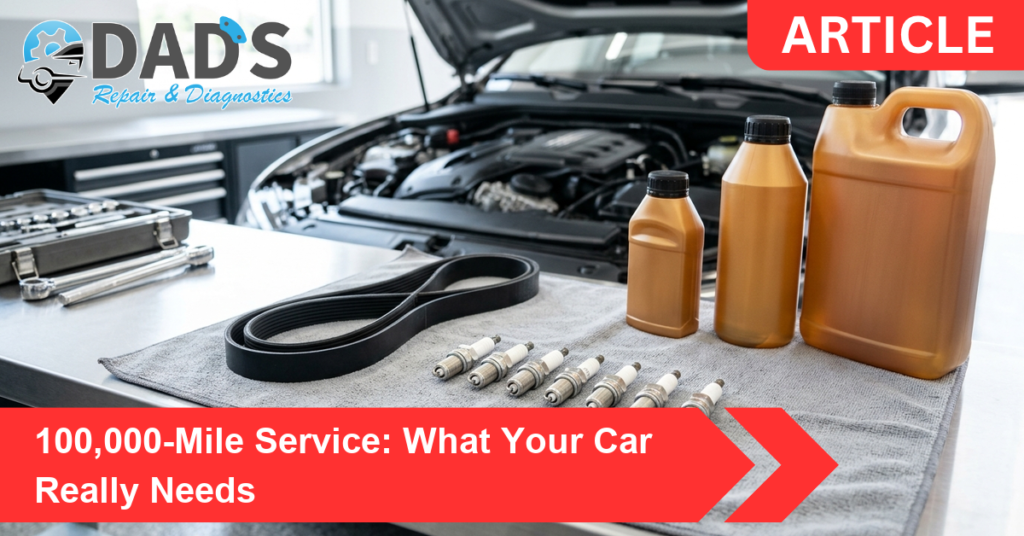
Rolling past six figures on the odometer is a milestone, and the 100,000-mile service is where a well-kept car either earns another decade or starts nickel-and-diming you. At DADS Auto Repair in Madera, we see the same split all the time: cars that got this work done run clean into 200,000 miles, while the ones that skipped it show up on a flatbed. Here is what your car really needs at this mark, and just as important, what it does not.
The goal is not a blank-check list of everything a shop could touch. It is matching the work to your specific vehicle and how it has lived its life in the Central Valley.
What a 100,000-Mile Service Actually Covers
A real 100,000-mile service is less a single job and more a coordinated catch-up on every part that wears on a time-and-mileage clock. Think fluids that have broken down, rubber that has hardened, and ignition parts that are past their prime. Most of these items were designed to last roughly this long, so they come due as a group. Knocking them out together is cheaper and safer than waiting for each one to fail on Highway 99.
Our valley climate speeds up part of that clock. Summer heat and the constant fine dust age fluids, hoses, and seals faster than the mild coastal climates many maintenance charts assume. A car that has spent 100,000 miles around Madera, CA has usually worked a little harder than its mileage suggests.
Timing Belt and Water Pump: The One You Cannot Skip
If your engine uses a rubber timing belt, this is the headline item. Many belts are due between 90,000 and 105,000 miles, and on an interference engine a snapped belt lets the valves and pistons collide, which turns a planned repair into a new engine. Because the water pump is often driven by that same belt and buried behind it, replacing both at once saves a second round of labor later. Our guide to timing belt failure spells out what happens when this gets ignored.
Not every car has a belt. Plenty of modern engines use a timing chain meant to last the life of the engine, and those owners can skip this expense entirely. Knowing which one you have is the first thing we confirm, because it is the single biggest swing in what this service costs.
Spark Plugs, Fluids, and Filters
Most long-life spark plugs are rated right around the 100,000-mile mark. Worn plugs show up as rough idle, weaker fuel economy, and harder starts, and fresh ones restore a surprising amount of crispness. If you want the detail, here is how spark plugs work and why they wear out.
Fluids are the quiet half of this visit. Transmission fluid, coolant, brake fluid, and differential or transfer-case fluid on trucks all break down with heat and miles. Old coolant turns acidic and eats at the radiator and water pump. Old brake fluid absorbs moisture and softens the pedal. A clean flush schedule is some of the cheapest protection you can buy.
- Transmission fluid — worn fluid leads to harsh or slipping shifts and shortens the transmission’s life.
- Coolant — past its service life it stops protecting against corrosion and overheating.
- Brake fluid — absorbs water over time, which hurts stopping power.
- Engine air and cabin filters — the valley’s dust clogs both faster than average.
Suspension, Hoses, and the Parts That Quietly Wear
By 100,000 miles, shocks and struts have softened, so the car floats over bumps and takes longer to settle. Rubber bushings, belts, and radiator and heater hoses have hardened and may be cracking. None of these shout for attention the way a warning light does, which is why a hands-on inspection matters more than a code reader here. We check them on the lift and show you what is actually worn.
Why 100,000 Miles Is About Time as Much as Mileage
Mileage is only half the clock. Rubber and fluids age by the calendar too, so a six-year-old car with 100,000 miles and a twelve-year-old car with the same reading are not in the same shape. Hoses get brittle, belts crack, and coolant loses its protective additives whether the car is driven hard or sits in the Madera heat. When we look at a high-mileage car, we weigh its age alongside the odometer, because a part that is both old and well-used is the one most likely to strand you.
Battery, Belts, and the Small Stuff
Some of the cheapest items on this visit prevent the most annoying failures. A battery near the 100,000-mile mark is usually on borrowed time, and our summer heat is brutal on batteries, often killing them faster than cold ever would. The serpentine belt that drives your accessories stretches and cracks with age, and a failed one can leave you without charging or power steering on the road. We also check the brakes, since a decade of driving usually means pads, and sometimes rotors, are due. None of this is glamorous, but it is what keeps a high-mileage car dependable.
Transmission service deserves a special note at this mileage. If the fluid has never been changed, we check its condition carefully before recommending a service, because on a neglected high-mileage automatic a sudden full flush can occasionally do more harm than good. This is exactly the kind of judgment call a diagnostics-first inspection handles better than a one-size-fits-all menu.
What You Can Skip, and the Upsell to Watch For
This is where an honest shop earns its keep. Not every car needs every item on a glossy 100k menu. A timing-chain engine does not need a belt job. A transmission that was serviced recently does not need another flush. Expensive engine and fuel system decarbonizing packages are rarely necessary on a well-maintained car. We would rather tell you to wait on something than sell it to you early, which is the whole idea behind “We Diagnose, We Do Not Guess.”
100,000-Mile Service Cost in Madera
Because the work depends so heavily on belt versus chain and which fluids are due, there is no single sticker price. A car that only needs plugs, fluids, and filters is a modest bill. Add a timing belt and water pump on an interference engine and it climbs. We inspect your vehicle, map it against the manufacturer’s schedule, and give you a written estimate before anything starts, so you can approve the work in the order that makes sense for your budget. Folks who search for Madera Auto Repair at this milestone usually want one straight answer: is the car worth keeping? In most cases a well-maintained vehicle at 100,000 miles has plenty of life left, and this service is what makes that possible. Our scheduled services page covers how we handle these milestone visits.
Hitting 100,000 miles is a good thing. Handled right, this service is the step that keeps your car dependable for years. If you are near that number, bring it to DADS Auto Repair in Madera and we will tell you exactly what it needs, and what it does not.
100,000-Mile Service FAQs
Is a 100,000-mile service really necessary?
How much does a 100,000-mile service cost?
What is the most important item at 100,000 miles?
More Scheduled Maintenance Tips
 Scheduled Maintenance
Spring Car Care: Top 10 Maintenance Tasks For The Heat
As the winter chill fades away and the sun starts beating down on Madera, your vehicle feels the shift just…
Read the article → Scheduled Maintenance
Great Rain Repellent Options for Safer Driving This Winter
Driving in a heavy downpour can make you realize just how important a clear windshield really is. Between the glare…
Read the article → Scheduled Maintenance
Why Some Cars Require OEM Fluids for Long-Term Reliability
It’s easy to assume that all fluids are the same — especially when the bottles look alike and promise compatibility.…
Read the article →Questions About Your Vehicle?
Our ASE-certified team is here to help — honest diagnosis, clear estimates, and a courtesy vehicle inspection with each visit.


