
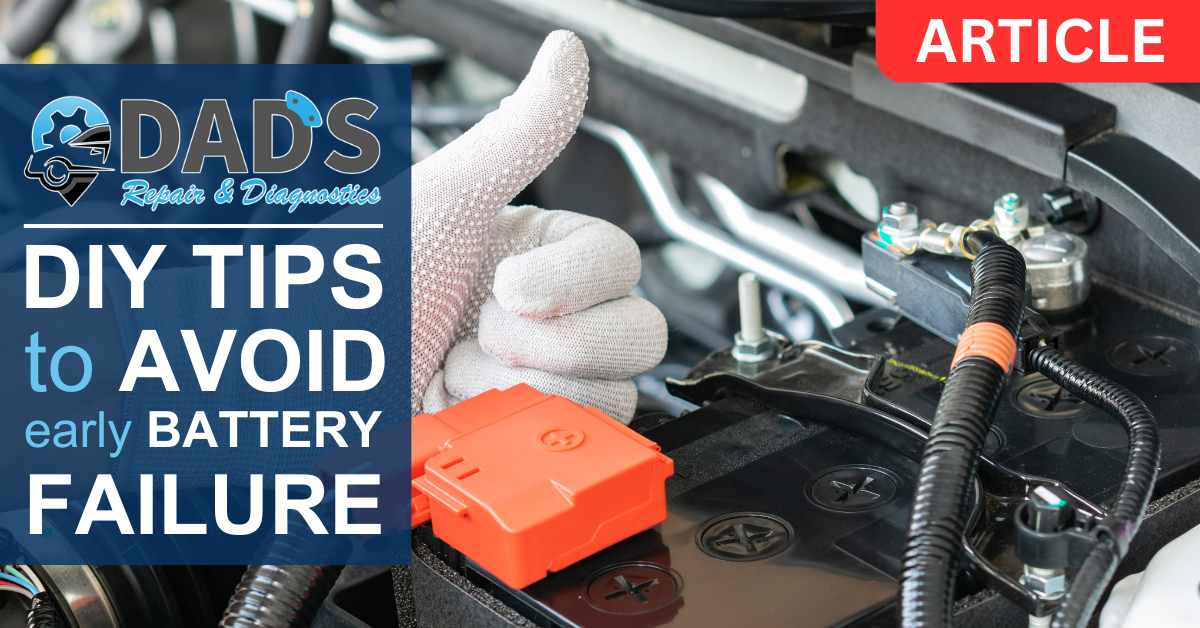
A car battery is one of the few parts you can genuinely help take care of yourself, and a little attention goes a long way toward avoiding a no-start and squeezing full life out of an expensive part. This guide covers the DIY battery maintenance worth doing, how to do it safely, and the warning signs that mean it is time to let a shop take over – especially in our hard-on-batteries Central Valley climate.
Start With a Regular Visual Inspection
Once a month, pop the hood and look at the battery. You are checking for white or bluish powder (corrosion) on the terminals, a swollen or cracked case, any leaking fluid, and a loose hold-down. Catching corrosion or a loose connection early prevents the slow, frustrating starting problems that send most people to the shop in the first place. Keeping the battery and its tray clean and dry is half the battle.
How to Clean Corroded Battery Terminals
Corrosion at the terminals blocks current and can keep a perfectly good battery from starting the car. You can clean it with household supplies:
- Turn the car off and take out the keys.
- Loosen and remove the cables – negative (-) first, then positive (+). Always disconnect negative first to avoid a short against the body.
- Mix a paste of one tablespoon baking soda in a cup of warm water.
- Scrub the terminals and clamps with an old toothbrush dipped in the paste until the powder dissolves.
- Rinse with clean water and dry thoroughly with a cloth.
- Reconnect positive (+) first, then negative (-), and make sure both are snug.
A thin smear of dielectric grease or a felt anti-corrosion washer on each post slows the buildup from coming back. If your car relies on saved settings or security codes, a plug-in memory saver keeps them alive while the battery is disconnected.
Keep the Battery Secured
Make sure the battery is clamped down firmly in its bracket. A battery that can bounce and vibrate – especially on our rougher roads – suffers internal damage that shortens its life and can even crack the case. This thirty-second check is one of the most commonly overlooked items under the hood. While you are there, make sure the hold-down hardware itself is not badly corroded, since a rusted bracket can let the battery shift even when it looks snug.
Check the Charge Level
With an inexpensive multimeter you can check the battery’s resting voltage with the engine off:
- A fully charged battery reads about 12.6 volts or a little higher.
- Around 12.4 volts it is roughly 75 percent charged.
- At 12.2 volts or below it is low and should be recharged and investigated.
One honest limitation: voltage alone does not tell the whole story. A battery can read a healthy 12.6 volts at rest and still fail under the load of actually cranking the engine. That is why a shop uses a load tester – here is how we safely test, charge, or replace a battery when the DIY check is not conclusive.
Why Our Climate Is So Hard on Batteries
It is worth understanding why a battery that might last six years in a mild coastal town often needs replacing in three or four here. A battery makes power through a chemical reaction in a liquid (or absorbed) electrolyte, and heat speeds up every chemical process – including the destructive ones. Sustained 100-plus-degree heat evaporates water out of the electrolyte, warps the internal plates, and accelerates the corrosion that eventually breaks the internal connections. The battery can look and even test fine right up until it cannot deliver a big cranking load.
That is why the advice here is different from what you might read for a cold-climate driver. Shade and garage parking genuinely extend battery life in the Valley, and an annual load test once the battery passes three years old catches the heat damage before it strands you. Do not wait for winter to think about the battery – our summers are what wear it out.
Habits That Quietly Kill Batteries
- A steady diet of short trips never lets the alternator fully recharge, leaving the battery chronically undercharged. Take a longer drive now and then.
- Leaving lights or accessories on with the engine off drains it – and a hidden always-on draw can do the same (see parasitic draws).
- Running the stereo and AC while idling for long stretches pulls more than the engine is replacing at idle.
- Extreme temperatures – our summer heat above all – shorten life, so parking in shade or a garage genuinely helps. Here is why summer heat is so hard on batteries.
AGM vs. Flooded, and When to Replace
Most older vehicles use a traditional flooded battery; many newer ones (especially with stop-start systems) use a sealed AGM battery. AGM batteries are maintenance-free inside and must be charged with an AGM-compatible charger – do not try to open or top one off. Either way, most batteries last three to five years, and our heat pushes that shorter. When yours is spent, it should be recycled, not trashed – the lead and acid are hazardous and valuable; here is why battery recycling matters and why any shop (including ours) will take the old one.
Clear Signs It Is Time for a New Battery
No amount of cleaning or charging revives a battery that is simply worn out. Plan a replacement when you see slow cranking, headlights dimming at idle, repeated jump starts, a battery that will not hold a charge overnight, a swollen case, or a sulfur smell under the hood. Age matters too: once a battery passes three years in our climate, treat every season as borrowed time and have it load-tested. Replacing a tired battery on your schedule costs the same as replacing a dead one – minus the tow and the ruined morning.
Frequently Asked Questions
How often should I check my battery? A quick visual check monthly and a voltage check every few months is plenty for most drivers. In summer, lean toward the more frequent end.
Do I really need to disconnect the negative terminal first? Yes. Removing negative first means that if your wrench touches metal while you work on the positive side, there is no complete circuit to spark. Reconnect it last.
My battery is new but keeps dying – what gives? That usually is not the battery. It is often a charging-system fault or a parasitic drain, both of which need testing to pin down. Call us at (559) 674-8207 and we will find the real cause.
Can I add water to my battery? Only if it is a traditional flooded battery with removable caps, and only with distilled water, filled just to cover the plates. Sealed and AGM batteries are not meant to be opened – trying to do so damages them. When in doubt, have it checked rather than guessing.
Good habits keep a battery reliable, but when the DIY checks say something is off, a proper test settles it fast.
Need battery or auto electrical service in Madera, CA? Schedule service with Donovan Automotive Diagnostic & Service (DADS) – call (559) 674-8207 or book online.