
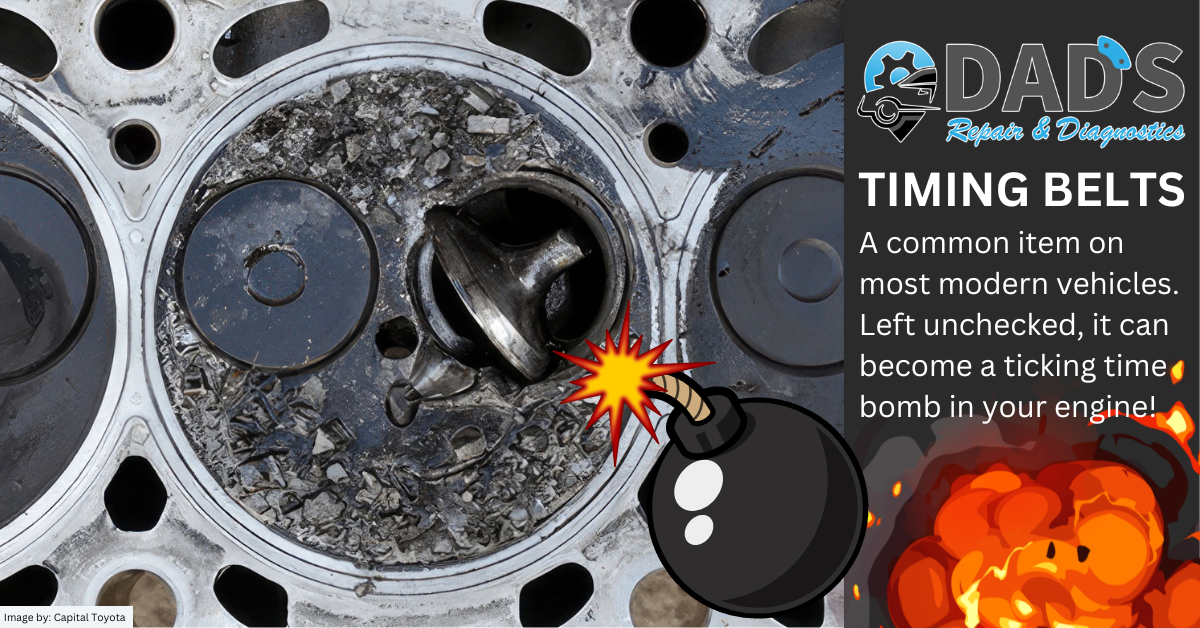
Few parts on your car work as hard, or hide as well, as the timing belt. It spins quietly behind a plastic cover, synchronizing the top and bottom halves of your engine thousands of times a minute, and most drivers never think about it until it is too late. Here in Madera, we see the aftermath more often than we would like: a car that was running fine one minute and dead on the shoulder of Highway 99 the next, with a repair bill that can rival the value of the vehicle. The good news is that timing belt failure is almost entirely preventable. If you understand what the belt does, whether your engine even has one, and when the manufacturer wants it replaced, you can avoid one of the most expensive surprises in car ownership.
At DADS Auto Repair, our motto is “We Diagnose, We Don’t Guess,” and that applies to the timing belt as much as anything else. Chris Donovan has spent more than 40 years as an ASE Master Technician, and timing belt service is one of those jobs where experience and precision genuinely matter. Get the timing off by even a tooth and the engine runs rough or not at all. Below is the straight story on timing belts, chains, interference engines, and why doing the job on schedule is one of the smartest moves a Central Valley driver can make.
What a Timing Belt Actually Does
Your engine has two main rotating assemblies that must stay in perfect step. The crankshaft, down low, is turned by the pistons. The camshaft (or camshafts) up top opens and closes the valves that let air and fuel in and exhaust out. The timing belt is the toothed rubber band that links the two so the valves open and close at exactly the right moment relative to the pistons moving up and down. When everything is in sync, the engine breathes cleanly and makes power. When the belt stretches, slips a tooth, or snaps, that synchronization is lost instantly.
Because the belt is made of reinforced rubber, it wears. Heat, oil contamination, age, and simple mileage all break it down over time. That is very different from a part that is designed to last the life of the car, and it is exactly why manufacturers put a replacement interval on it. A timing belt is a scheduled wear item, not a lifetime part.
Timing Belt vs. Timing Chain: Which Does Your Car Have?
This is the first question we ask, because it changes everything. Some engines use a timing belt and some use a timing chain, and they are maintained very differently.
- Timing belt: A rubber toothed belt that must be replaced at a set interval, typically between 60,000 and 100,000 miles depending on the manufacturer. Many Honda, Toyota, Subaru, Volkswagen, and older Kia and Hyundai engines have used belts.
- Timing chain: A metal chain, lubricated by engine oil, that is generally designed to last much longer – often the life of the engine – as long as you keep up with oil changes. Chains can still wear or stretch, especially if oil service is neglected, but they have no fixed replacement interval the way belts do.
The tricky part is that you usually cannot tell which one you have just by looking, and manufacturers have switched back and forth even within the same model line over the years. We look it up by your exact year, make, model, and engine before we tell you anything. If you are already noticing the engine feel weak or hesitant, that can have many causes, and our writeup on the common reasons your engine is losing power walks through several of them.
Interference vs. Non-Interference Engines: Why It Matters So Much
Here is the single most important concept in this entire article. Engines come in two designs, and the difference decides whether a broken belt is an inconvenience or a catastrophe.
In an interference engine, the valves and the pistons share the same space inside the cylinder at different moments in time. The timing belt is what keeps them from ever being there at the same instant. If the belt snaps while the engine is running, the camshaft stops but the pistons keep flying up on their own momentum. Open valves get slammed by rising pistons. The result is bent valves, damaged pistons, and sometimes a cracked cylinder head or scored cylinder walls. What should have been a routine belt job becomes a teardown and rebuild that can run into the thousands.
In a non-interference engine, the pistons and valves never occupy the same space. If the belt breaks, the engine simply stalls and coasts to a stop with no internal contact. You still need a tow and a new belt, but the engine itself is usually unharmed. The problem is that a large share of modern engines are the interference type, so you should never assume yours is forgiving. We confirm your engine’s design before quoting anything, and if you do experience a sudden stall, our guide on why a car’s engine suddenly stops running covers what to do and what we check.
When to Replace Your Timing Belt
The honest answer is: whatever your owner’s manual says, and not a mile later. Intervals commonly fall between 60,000 and 100,000 miles, but some are tied to time as well – for example, 7 or 10 years, whichever comes first. Time matters because rubber degrades even on a low-mileage car that mostly sits. A belt that looks fine can be brittle on the inside.
Madera adds its own stress. Our brutal summer heat bakes everything under the hood, and heat is hard on rubber. Dust off the ag roads and the long climbs toward the Sierra put the belt under sustained load in high temperatures. All of that argues for treating the interval as a firm deadline, not a loose suggestion. If your car is approaching the mileage and you have no record of the belt ever being done, assume it is original and get it inspected.
Warning Signs to Watch For
Timing belts often fail with no warning at all, which is why the mileage interval is your real protection. But some symptoms can hint at trouble before a complete failure:
- A ticking or slapping noise coming from the front of the engine
- The engine is hard to start or cranks unevenly
- A rough idle or occasional misfire
- Visible cracks, glazing, or missing teeth if the cover is removed during service
- Oil or coolant leaks near the timing cover that can contaminate and shorten belt life
Do not confuse the timing belt with the belt you can usually see – that is the serpentine belt, which drives the alternator, water pump on some engines, and AC. It has its own symptoms, which we cover in serpentine belt warning signs you should not ignore.
Why We Replace the Water Pump at the Same Time
On many engines the water pump is driven by the timing belt and lives right behind the same covers. Getting to it requires most of the same labor as the belt job itself. Since the water pump is also a wear item with a similar lifespan, replacing it at the same time is simply smart economics. You pay the labor once instead of twice, and you are not back in the shop a year later tearing the front of the engine apart again because a pump that was already apparent decided to fail.
We also recommend replacing the tensioner and idler pulleys in the same visit. These spin constantly and their bearings wear. A fresh belt on a worn-out tensioner is a false economy. When DADS does a timing belt, we do the whole job right the first time, which is the kind of thorough preventive work the folks at the Car Care Council consistently recommend to keep a vehicle dependable.
What Timing Belt Service Looks Like at DADS
Because our shop diagnoses rather than guesses, every timing belt job starts with confirming the facts specific to your vehicle: belt or chain, interference or non-interference, the exact factory interval, and whether the water pump and tensioner are belt-driven. From there we remove the covers, set the engine to the correct timing marks, and install the new belt, tensioner, idlers, and water pump as a package where applicable. We then rotate the engine by hand to verify timing before it ever starts, so there is no guesswork and no risk of a mistimed first crank. It is detailed work, and it is exactly the kind of job where a 40-year ASE Master Technician earns his keep.
Frequently Asked Questions About Timing Belt Failure
How much does it cost to fix an engine after a timing belt breaks? On a non-interference engine, often just the cost of the belt and a tow. On an interference engine, a snapped belt can bend valves and damage pistons, turning a few-hundred-dollar maintenance job into a repair that can run into the thousands. That gap is the entire reason we push people to replace the belt on schedule.
How do I know if my car has a timing belt or a timing chain? You generally cannot tell by looking, and manufacturers have changed designs even within the same model over the years. Give us your year, make, model, and engine size and we will tell you exactly which one you have and what the factory interval is.
My car has low miles but it is 10 years old. Do I still need the belt replaced? Most likely yes. Many intervals are based on time as well as mileage because rubber dries out and gets brittle with age regardless of how far you drive. A garage-kept car with original rubber can still fail.
Should I really pay to replace the water pump too? On engines where the pump is driven by the timing belt, yes. The labor to reach it is nearly identical to the belt job, so replacing both at once saves you a second large labor bill later. We will tell you honestly whether your engine is one of those – just call us at (559) 674-8207.
A timing belt is out of sight, but it should never be out of mind. It is one of the rare parts where a modest, scheduled investment protects you from one of the largest repair bills your car can hand you. If you are anywhere near your replacement interval, or you simply are not sure when it was last done, let us pull the records and take a look before the Valley heat and the next Sierra road trip make the decision for you.
Need timing belt service in Madera, CA? Schedule timing belt service with Donovan Automotive Diagnostic & Service (DADS) – call (559) 674-8207 or book online.